
03.26.2026
Pictured: Rosanna stands outside on a leafy lawn. She is wearing a blue shirt and dark cardigan. She holds glasses in her left hand.
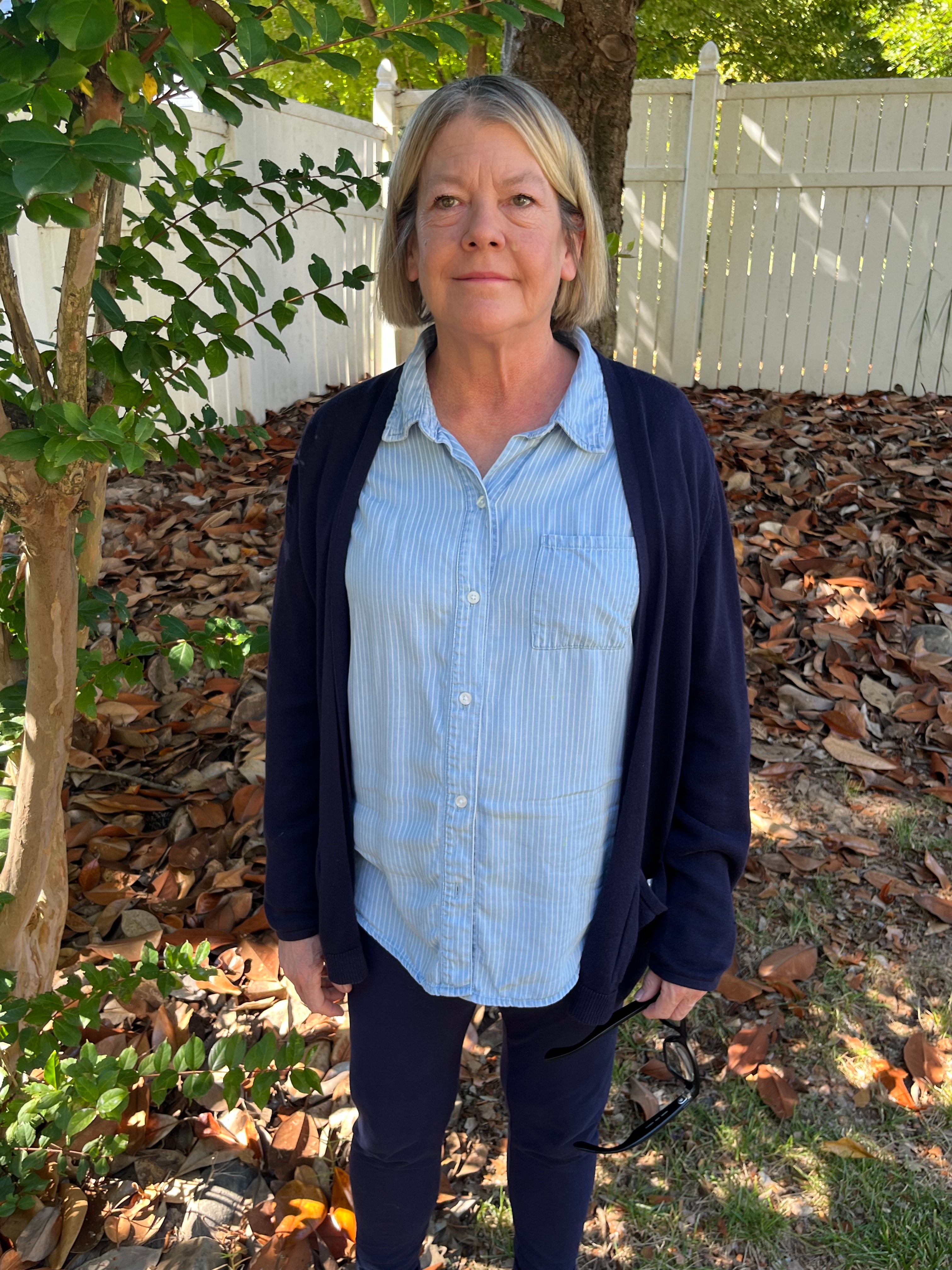
Rosanna Seitter’s life has been adventurous and visual. She grew up in northern California with parents who limited TV time to two hours a week; thus, she spent lots of time outside exploring. She attended University of California at Berkeley, graduating with a degree in Physical Anthropology. During college she spent time hiking up the hills of Berkeley to study a troupe of langur monkeys.
Rosanna eventually earned a master’s degree in public relations and moved to Charlotte, NC, where she quickly got a job in communications relations at WSOC TV. At WSOC TV, Rosanna coordinated all the station-wide events for a 22-county region like School Tools, Steve’s Coats for Kids, etc. In conjunction with that work, she taught herself, along with the station’s videographers, to produce videos to promote the events. One video Rosanna and her colleagues created won a regional Emmy Award, an experience that Rosanna says, “invigorated me even more to get into videos.”
Rosanna was then recruited to work as a public information officer and video producer for Mecklenburg County. “We had a great time producing videos highlighting the county’s 250-year history, Veteran’s Services, the health department, and county parks and greenways,” she recalled.
Then about 12 years ago, Rosanna began to lose her vision. Her ophthalmologist diagnosed her with age-related macular degeneration (AMD), a medical condition that affects the central part of the retina, leading to blurred or no vision in the center of the visual field. At this point, her vision could not be corrected by traditional lenses or surgery, so he referred her to Dr. Laurie Hoffman, Metrolina Association for the Blind’s (MAB) low vision optometrist.
Like Rosanna, for many of MAB’s clients, a physician referral is their first exposure to MAB. “That’s how I found out about MAB,” she explained. “Doctor Hoffman explained that there is no cure, and helped me get some magnifying devices.”
Eventually, Rosanna had to leave her job with Mecklenburg County because her vision loss made it virtually impossible to do the work she had been doing. Still, MAB’s services have helped enable her to continue to remain independent and active. For example, MAB’s independent living courses (called mini centers) and assistive technology (AT) trainings helped her make her home more navigable and to use tools and devices to manage paperwork and family finances.
“I have reorganized the pantry, and I have a label maker for labeling spices and other things. These are things I learned at MAB’s mini centers.” An avid reader, Rosanna has been using audio books provided at no charge by the Library of Congress.
Some of the other tools Rosanna has learned to use through MAB training include magnifiers, lined high contrast paper, and apps on her iPhone like Be My Eyes and Seeing AI. She recently got Meta AI glasses and has been learning how to use them effectively during her AT sessions at MAB. Thanks to the glasses, she said, “I went to an Italian restaurant and it was the first time in a while that my husband, Dell, didn’t have to read the menu to me!”
MAB’s door-through-door transportation services make it easier for Rosanna to travel to classes and appointments and allow her to be less reliant on her husband for rides. “To have...Grover come and pick me up and take me to Joseph’s (AT) classes, mini centers, and doctors’ appointments is unbelievably invaluable. My husband is great, but he works and he can’t take me to every appointment. I can’t imagine not having MAB.”
While she has received cane training through MAB, Rosanna currently has enough vision to navigate familiar surroundings without her cane for the time being. She realizes, however, the importance of practicing her travel skills for when that changes. A harrowing experience a few years ago reminded her of this fact.
“Several years ago we were going to California to see my mom who was sick. I had TSA pre-check, but Dell didn’t. I had sort of a panic attack because he wasn’t there, and I didn’t have my cane. I just sat on a bench and waited until he found me and we went to the gate together. If I’m in an unfamiliar place, I sort of stress out.”
Such stress is all too common for people who are dealing with vision loss. In addition, people with visual impairment often experience social isolation and are three times more likely to suffer from depression. The good news is that these feelings can be lessened by the confidence-boosting skills training and support groups offered at MAB.
When asked what advice she would give to others who are dealing with progressive vision loss, Rosanna answered, “Accept it. It’s not going away. But try to be upbeat. Take advantage of all the things that are available to people with vision loss. There’s a lot out there.
“MAB has been a lifesaver for me. I genuinely feel happy, and I know that although this (vision loss) is what was given to me, I can take advantage of MAB’s services and devices.”
Rosanna’s creative skills are coming full circle. She has offered her time and talents to develop a video about MAB to educate the community about all the services MAB provides and encourage viewers to support MAB. Enlisting the help of the videographer with whom she previously worked, she has found a way to support MAB and spread the word about MAB’s services.
“I’m not rich,” Rosanna said. “I can’t give $50,000 to MAB. But I hope that by making this in-kind video I will help MAB.”
« Back


Comments:
No comments posted yet
Leave a Comment: